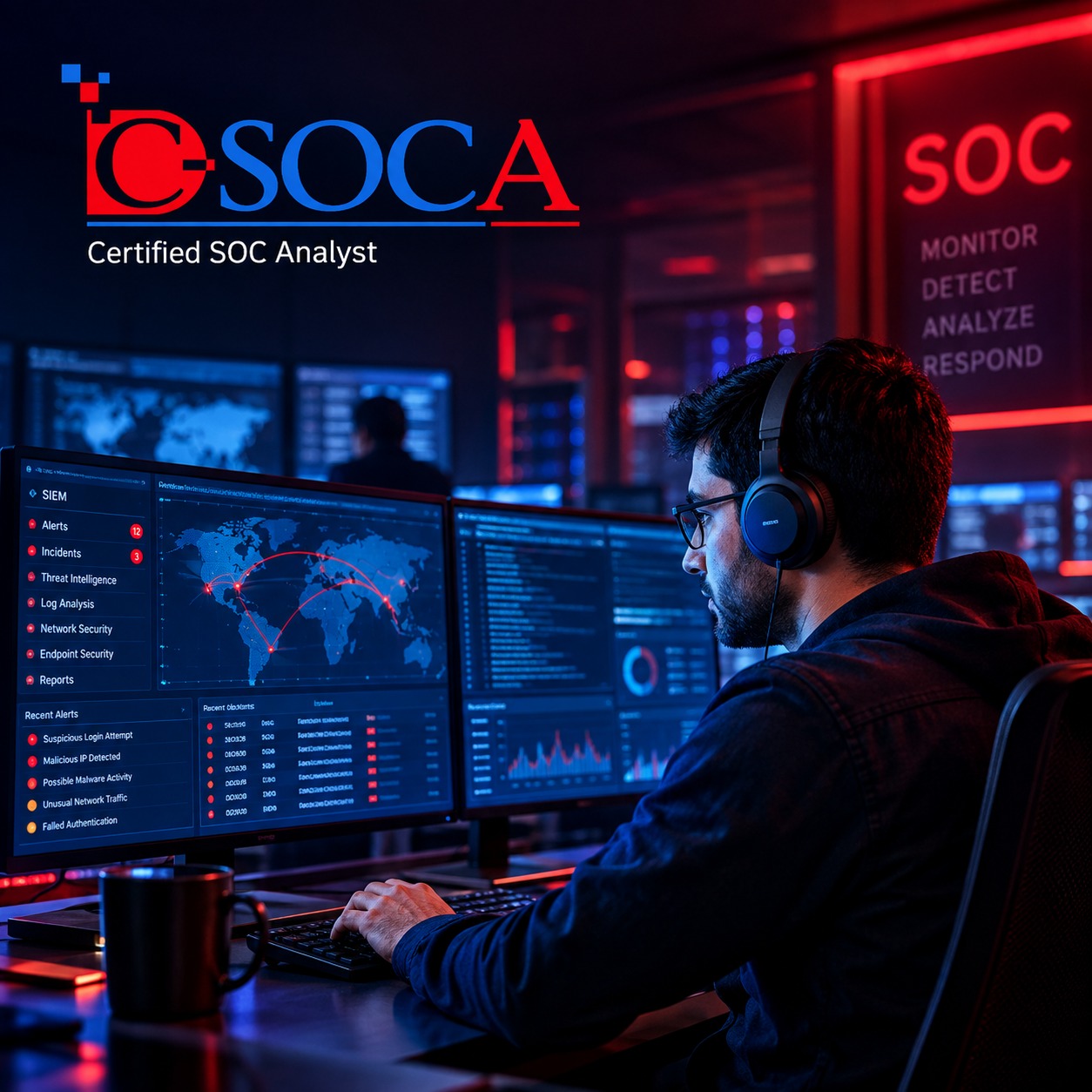
1. SOC Fundamentals
Understand the role and responsibilities of a Security Operations Center
and how SOC teams work together to protect organizational infrastructure.
2. Security Monitoring
Learn the fundamentals of continuously monitoring systems, networks,
endpoints, and security events to identify suspicious behavior. You will understand how security
analysts review alerts and differentiate between normal activities, suspicious activities, and
potential security incidents.
3. Log Analysis
Logs provide valuable information about activities occurring across
systems and networks. Learn the fundamentals of:
4. SIEM Fundamentals
Security Information and Event Management (SIEM) solutions are widely used
in security operations to collect, centralize, correlate, and analyze security events. The
course introduces students to SIEM concepts, including:
5. Threat Detection
Learn how cybersecurity analysts identify suspicious patterns and
potential Indicators of Compromise. You will understand concepts such as:
6. Incident Response
Understand the fundamental stages involved in responding to cybersecurity
incidents. The training covers concepts related to:
7. Threat Intelligence
Learn how threat intelligence can support security monitoring and
incident investigation. Understand different types of threat intelligence and how information
about malicious IP addresses, domains, malware, vulnerabilities, and threat actors can assist
security teams.
8. Network Security Monitoring
Understand how network traffic and network security events can be
monitored to identify suspicious activities. Students are introduced to concepts involving: