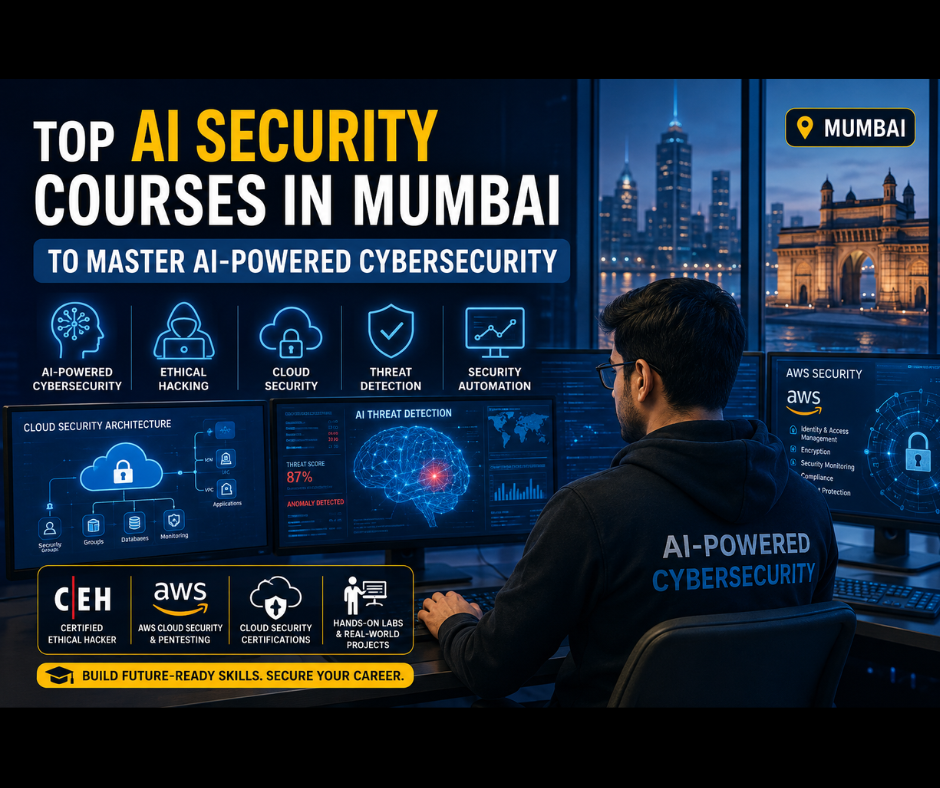
Artificial intelligence is changing cybersecurity faster than many organizations expected. Security teams are now using AI to identify suspicious activity, analyze large volumes of security data, detect unusual behavior, automate incident response, and strengthen threat intelligence. At the same time, attackers are also using AI to create more sophisticated phishing campaigns, automate reconnaissance, generate malicious code, and discover weaknesses faster.
This shift has created a growing demand for professionals who understand both artificial intelligence and cybersecurity.
For students, fresh graduates, IT professionals, network engineers, ethical hackers, and cloud professionals in Mumbai, learning AI-powered cybersecurity can open the door to emerging career opportunities. The right training can help learners understand AI security, ethical hacking, cloud protection, penetration testing, network defense, and security automation.
This guide explores the top AI security courses in Mumbai, what you should learn, how cloud security certifications fit into an AI-security career, and how to choose the right cybersecurity training program.
What Is AI-Powered Cybersecurity?
AI-powered cybersecurity combines artificial intelligence, machine learning, automation, and traditional security practices to identify and respond to cyber threats.
Instead of depending entirely on manual investigation, security professionals can use AI-based systems to process large datasets and identify patterns that may indicate an attack.
Common applications include:
- AI-assisted threat detection
- Security event analysis
- Malware detection
- Phishing identification
- User and entity behavior analytics
- Automated incident response
- Threat intelligence
- Vulnerability assessment
- Security operations center automation
- Cloud security monitoring
- AI-assisted penetration testing
For example, an AI-enabled security platform can analyze thousands of login events and identify unusual behavior that might otherwise take a security analyst much longer to investigate.
Why Learn AI Security in Mumbai?
Mumbai is one of India's major technology and business centers, with opportunities across IT services, financial services, consulting, cloud computing, software development, and cybersecurity.
As organizations move workloads to cloud platforms and increasingly adopt AI applications, cybersecurity professionals need skills beyond conventional network security.
A modern cybersecurity learner may need knowledge of:
Cybersecurity + Ethical Hacking + Cloud Security + AI + Networking + Automation
This combination can make a professional more versatile when applying for roles such as:
- Cybersecurity Analyst
- Security Operations Center (SOC) Analyst
- Ethical Hacker
- Penetration Tester
- Cloud Security Analyst
- Network Security Engineer
- Application Security Analyst
- AI Security Professional
- Security Engineer
- Threat Intelligence Analyst
Top AI Security Courses in Mumbai
When searching for the top AI security courses in Mumbai, students should look beyond course titles. A strong program should combine cybersecurity fundamentals with practical labs and emerging AI-driven security concepts.
1. AI Cybersecurity & Ethical Hacking
An AI-focused cybersecurity and ethical hacking program can provide a foundation in both offensive and defensive security.
Typical areas covered may include:
- Cybersecurity fundamentals
- Linux security
- Networking fundamentals
- Reconnaissance
- Web security
- Vulnerability assessment
- Penetration testing
- Password security
- Malware concepts
- Security tools
- AI-assisted security analysis
- Security automation
This type of course can be suitable for beginners who want to build a career in cybersecurity while developing an understanding of AI.
2. Certified Ethical Hacker (CEH) Training
CEH training in Mumbai is another popular option for learners interested in ethical hacking.
A certified ethical hacker course generally introduces students to penetration testing methodologies, reconnaissance, scanning, system security, web application security, wireless security, social engineering concepts, and defensive countermeasures.
For learners specifically searching for a CEH course in Mumbai, choosing a training program with practical labs is important. Cybersecurity is a hands-on field, and theoretical knowledge alone may not be enough to develop job-ready skills.
3. Cloud Security Certifications
Cloud adoption has made cloud security an essential cybersecurity specialization.
Cloud Security Certifications can help professionals understand how security controls work across cloud infrastructure, applications, identities, networks, and data.
Important cloud security topics include:
- Cloud identity and access management
- Cloud network security
- Data protection
- Security monitoring
- Cloud incident response
- Container security
- Infrastructure security
- Cloud compliance
- Zero Trust principles
- Secure cloud architecture
Professionals looking for specialized training can consider Certified Cloud Security Professional Training in Mumbai to develop practical knowledge of cloud security concepts.
Cloud security knowledge is especially valuable for cybersecurity professionals working with AWS, Azure, Google Cloud, and hybrid environments.
4. Certified AWS Cloud Security & Pentesting Professional Courses
AWS remains an important cloud platform for organizations of different sizes. Consequently, security professionals can benefit from understanding how to secure AWS environments and assess their security posture.
A Certified AWS Cloud Security & Pentesting Professional course in Mumbai may cover areas such as:
- AWS security fundamentals
- Identity and access management
- Cloud networking
- Storage security
- Security monitoring
- AWS logging
- Cloud penetration testing concepts
- Misconfiguration detection
- Secure cloud architecture
- Incident response
For someone pursuing both cloud security and ethical hacking, combining AWS security knowledge with penetration testing can create a useful skill set.
5. Network Security and Cyber Defense
Networking is the foundation of cybersecurity.
Before becoming an advanced security professional, learners should understand how networks operate and how attackers can abuse them.
Network security training may cover:
- TCP/IP
- Routing and switching
- Firewalls
- VPNs
- Network segmentation
- IDS and IPS
- Network monitoring
- Secure protocols
- Traffic analysis
- Network attacks
- Defensive security controls
Learners who want to strengthen their networking foundation can also explore professional networking certifications before progressing into advanced cybersecurity.
6. Penetration Testing Courses
Penetration testing remains an important cybersecurity specialization.
A penetration tester simulates authorized attacks against systems, applications, networks, APIs, or other assets to identify security weaknesses and help organizations improve their defenses.
Modern penetration testing can involve:
- Web application testing
- API security testing
- Network penetration testing
- Mobile application testing
- Cloud penetration testing
- Authentication testing
- Security configuration assessment
- Manual security testing
- AI-assisted security analysis
Students interested in an ethical hacking course in Mumbai should ideally choose a program that provides legal, controlled environments for practical testing.
How AI Is Changing Ethical Hacking
AI does not eliminate the need for cybersecurity professionals. Instead, it is becoming another tool in their toolkit.
AI can help security teams:
- Analyze security logs
- Summarize threat intelligence
- Identify suspicious patterns
- Automate repetitive tasks
- Generate test cases
- Assist with security research
- Prioritize security findings
- Improve incident investigation
For ethical hackers, AI can accelerate certain research and analysis tasks. However, professional judgment remains essential because AI-generated results must be validated before they are trusted.
This is why the combination of AI security training and ethical hacking training is becoming increasingly relevant.
What Should a Good AI Security Course Include?
If you are comparing the best cyber security institute or cybersecurity classes in Mumbai, look for a curriculum that balances theory, practical work, and current technologies.
A good AI cybersecurity program should ideally include:
Strong Cybersecurity Fundamentals
Students should understand networking, operating systems, authentication, access control, cryptography, and common attack techniques.
Ethical Hacking Skills
Practical training should introduce reconnaissance, security testing, web application security, network security, and penetration testing methodologies.
AI Security Concepts
The curriculum should explain how AI is used for detection, analysis, automation, threat intelligence, and security operations.
Cloud Security
Cloud platforms should be included because modern organizations increasingly operate hybrid and cloud-based environments.
Practical Labs
Hands-on labs allow students to apply concepts rather than simply memorize terminology.
Industry-Relevant Tools
Students should gain exposure to commonly used cybersecurity tools in controlled environments.
Certification Preparation
Professional certification preparation can provide a structured learning path and help demonstrate knowledge to potential employers.
AI Security + Cloud Security: A Powerful Combination
One of the most useful combinations for modern cybersecurity professionals is AI security and cloud security.
AI systems increasingly depend on cloud infrastructure, while cloud environments host sensitive applications, data, APIs, and machine-learning workloads.
This creates new security requirements around:
- AI model security
- Cloud access control
- Data protection
- API security
- Identity security
- Cloud workload protection
- AI governance
- Secure machine-learning pipelines
- Monitoring and incident response
Professionals who understand both cloud environments and AI-driven security can potentially work across multiple cybersecurity domains.
Who Should Join AI Security Courses in Mumbai?
AI security training can be suitable for:
- College students
- Recent graduates
- IT professionals
- Network engineers
- System administrators
- Cloud professionals
- Software developers
- Ethical hacking aspirants
- SOC analysts
- Cybersecurity professionals
- Professionals planning a cybersecurity career change
Beginners do not necessarily need to master AI before starting. A structured course can introduce cybersecurity fundamentals first and gradually move toward AI-powered security concepts.
How to Choose the Best Institute for Ethical Hacking in Navi Mumbai or Mumbai
Choosing a training institute should be based on more than advertisements or course fees.
Before enrolling, check:
- Curriculum: Does it cover current cybersecurity technologies?
- Practical labs: Can students practice security concepts in controlled environments?
- Trainer expertise: Do instructors have relevant industry experience?
- Certifications: Are recognized certifications included or supported?
- Projects: Does the program provide practical assignments?
- Career support: Is interview or placement assistance available?
- Learning format: Are classroom, online, or hybrid options available?
- Advanced topics: Does the course include cloud, AI, APIs, and modern security practices?
These factors can help students distinguish genuine skill-based cyber security classes from programs focused mainly on theory.
AI Security Career Roadmap for Beginners
If you are starting from zero, you do not need to learn everything at once.
A practical roadmap can look like this:
Step 1: Learn Networking
Understand TCP/IP, DNS, HTTP, routing, ports, protocols, and basic network architecture.
Step 2: Learn Operating Systems
Develop familiarity with Linux and Windows security concepts.
Step 3: Learn Cybersecurity Fundamentals
Understand authentication, access control, encryption, security monitoring, malware, phishing, and common attack techniques.
Step 4: Learn Ethical Hacking
Progress into reconnaissance, web security, network security, and penetration testing.
Step 5: Learn Cloud Security
Study cloud identity, network controls, data security, monitoring, and secure architecture.
Step 6: Learn AI for Cybersecurity
Understand AI-assisted detection, threat intelligence, security automation, and AI-specific security risks.
Step 7: Build Practical Projects
Use legal labs and controlled environments to demonstrate your skills.
Step 8: Prepare for Certifications
Select certifications that match your career goals and experience level.
AI Security vs Traditional Cybersecurity
Traditional cybersecurity relies heavily on predefined rules, signatures, manual investigation, and established security controls.
AI-powered cybersecurity can add:
- Pattern recognition
- Automated analysis
- Behavioral detection
- Faster investigation
- Intelligent prioritization
- Automated workflows
However, AI is not a replacement for cybersecurity fundamentals.
A professional who understands networking, operating systems, cloud infrastructure, security architecture, and ethical hacking will be better positioned to use AI effectively.
Final Thoughts
Cybersecurity is moving toward a more intelligent and automated future. AI is transforming how organizations detect threats, investigate incidents, monitor infrastructure, and respond to attacks.
For learners in Mumbai, this creates an opportunity to build a career around a combination of AI, cybersecurity, ethical hacking, cloud security, networking, and penetration testing.
Whether your goal is to pursue a CEH course in Mumbai, develop cloud expertise through Cloud Security Certifications, join Certified Cloud Security Professional Training in Mumbai, or explore Certified AWS Cloud Security & Pentesting Professional courses in Mumbai, choose a program that emphasizes practical learning and current industry skills.
The strongest cybersecurity professionals of the future will not simply know how to use security tools. They will understand how technology works, how attacks happen, how defenses can fail, and how AI can help security teams respond faster and smarter.
For students and IT professionals ready to enter this field, developing these skills today can provide a strong foundation for tomorrow's cybersecurity opportunities.
Frequently Asked Questions
What are the best AI security courses in Mumbai?
The best AI security course depends on your experience and career objective. Programs combining AI cybersecurity, ethical hacking, cloud security, penetration testing, and practical labs can provide a broader career-oriented foundation.
Is an AI security course suitable for beginners?
Yes. Beginners can start with cybersecurity and networking fundamentals before progressing toward AI-powered security concepts.
Is CEH useful for an ethical hacking career?
CEH can provide structured knowledge of ethical hacking concepts. Learners should also develop practical skills through authorized labs and security projects.
What is Certified Cloud Security Professional Training in Mumbai?
It is specialized training focused on protecting cloud infrastructure, applications, identities, networks, and data. It can be useful for professionals seeking a cloud security specialization.
Why combine AWS security and penetration testing?
AWS security teaches learners how to protect cloud environments, while penetration testing teaches them how to assess security controls through authorized testing. Together, they provide complementary skills.
Can AI replace ethical hackers?
AI can automate and accelerate some security tasks, but human expertise remains important for interpreting results, validating findings, understanding business context, and making security decisions.
Which is better: cybersecurity or AI cybersecurity?
AI cybersecurity builds on traditional cybersecurity rather than replacing it. A strong career path is to learn cybersecurity fundamentals first and then add AI, cloud, automation, and advanced security skills.