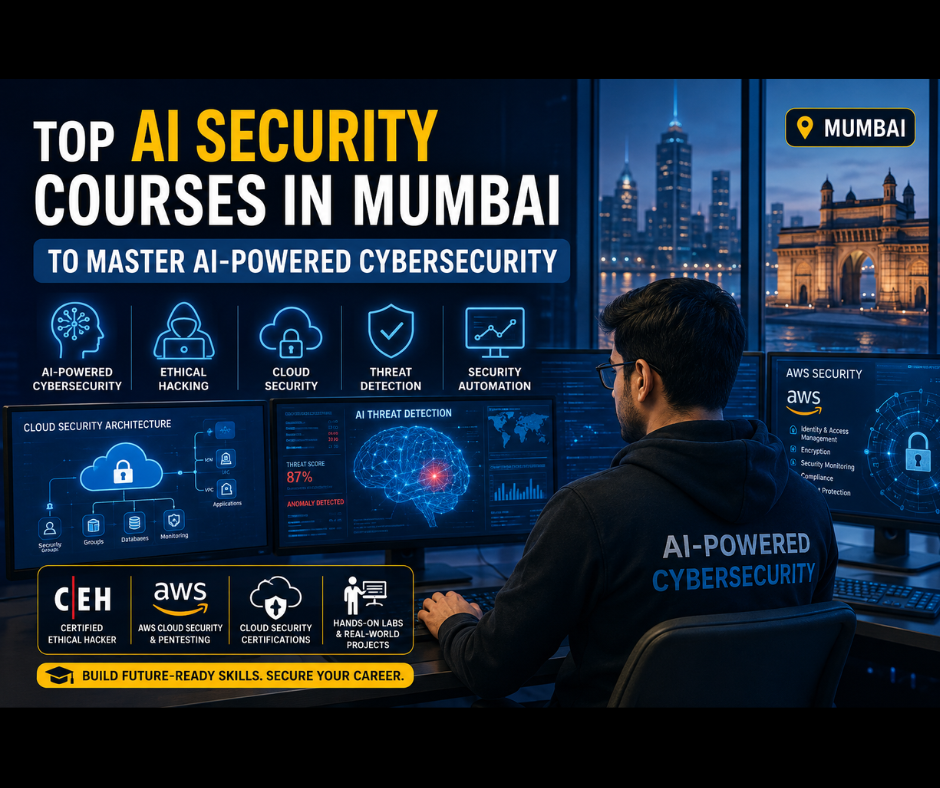
Artificial intelligence is changing the way businesses operate, but it is also changing the way cybercriminals attack. AI-powered phishing, automated vulnerability discovery, deepfakes, prompt injection, model manipulation, data poisoning, and attacks against AI applications are creating new security challenges.
This is why AI cybersecurity is becoming an important career specialization for students, ethical hackers, network professionals, cloud engineers, and IT professionals.
For anyone planning to enter this field, choosing the right training matters. The best AI security courses in Mumbai should not focus only on artificial intelligence concepts. They should combine cybersecurity fundamentals with practical AI security, ethical hacking, penetration testing, threat detection, and responsible use of AI tools.
If you are considering an AI Cyber Security Certification in Mumbai, this guide explains what to look for, what skills you can develop, career opportunities, and how to choose a suitable course.
What Is AI Cybersecurity?
AI cybersecurity refers to the use of artificial intelligence and machine learning technologies to improve cybersecurity while also protecting AI systems from cyberattacks.
It has two major sides:
- Using AI for cybersecurity – applying AI to threat detection, security monitoring, malware analysis, incident response, vulnerability analysis, and security automation.
- Securing AI systems – protecting AI models, applications, APIs, datasets, and infrastructure from attacks such as prompt injection, data poisoning, model manipulation, and unauthorized access.
A modern AI security professional therefore needs knowledge of both cybersecurity and artificial intelligence.
Why Learn AI Security in 2026?
Traditional cybersecurity is evolving rapidly. Security teams are increasingly using AI to analyze large volumes of security data and identify suspicious activity faster.
At the same time, organizations deploying generative AI applications need professionals who understand how those systems can be attacked and secured.
Some important areas include:
- AI threat detection
- Generative AI security
- LLM security
- Prompt injection testing
- AI application penetration testing
- Machine learning security
- API security
- Cloud security
- Ethical hacking
- Red teaming
- Security automation
- Threat intelligence
- Incident response
This combination makes AI cybersecurity a valuable specialization for professionals who want to build a future-focused cybersecurity career.
Top AI Security Courses in Mumbai
When comparing AI security courses in Mumbai, don't choose a program only because it contains “AI” in its name.
A strong course should provide a combination of cybersecurity fundamentals, AI security concepts, practical labs, attack simulations, and industry-relevant tools.
1. AI Cybersecurity & Ethical Hacking
An AI-focused cybersecurity and ethical hacking course can be a good starting point for students and professionals who want to understand both offensive and defensive security.
Typical areas may include:
- Cybersecurity fundamentals
- Ethical hacking methodology
- Network security
- Web application security
- Vulnerability assessment
- Penetration testing
- AI-assisted security testing
- Security automation
- Threat detection
- Basic red teaming
This type of training helps learners understand how attackers identify weaknesses and how defenders can protect systems.
2. AI Security and Red Teaming
Red teaming focuses on simulating realistic attacks against an organization's systems, applications, networks, and security controls.
An advanced AI security and red teaming course can cover areas such as:
- AI attack surfaces
- LLM security
- Prompt injection
- AI application testing
- Adversarial techniques
- Red team methodology
- Attack simulation
- Security assessment
- Reporting and remediation
This specialization can be particularly useful for ethical hackers and cybersecurity professionals who want to move into offensive security.
3. AI-Powered Penetration Testing
Penetration testing is one of the core skills used in cybersecurity.
AI can assist security professionals with tasks such as reconnaissance, information analysis, vulnerability prioritization, test-case generation, and security reporting.
However, AI should be treated as an assistant rather than a replacement for cybersecurity expertise.
A practical AI penetration testing program should therefore teach:
- Reconnaissance
- Network penetration testing
- Web application security testing
- API security testing
- Vulnerability analysis
- Exploitation concepts
- AI-assisted security workflows
- Reporting
- Remediation recommendations
4. AI Security for Cloud Environments
As organizations move workloads to AWS, Azure, and other cloud platforms, AI systems are increasingly deployed in cloud environments.
This creates a need for professionals who understand cloud security and AI security together.
A relevant course may cover:
- Cloud security fundamentals
- Identity and access management
- Cloud infrastructure security
- Secure AI deployment
- API security
- Data protection
- Cloud threat detection
- Security monitoring
- AI workload security
Combining cloud security with AI cybersecurity can create additional career opportunities.
What Should You Learn in an AI Cybersecurity Course?
Before enrolling in an AI Cyber Security Certification in Mumbai, check whether the curriculum includes practical and theoretical components.
Essential topics include:
Cybersecurity fundamentals:
Networking, operating systems, authentication, access control, encryption, security architecture, and common cyberattack techniques.
Ethical hacking:
Reconnaissance, scanning, enumeration, vulnerability assessment, exploitation concepts, and security reporting.
Artificial intelligence fundamentals:
Machine learning concepts, generative AI, large language models, AI applications, and common AI security challenges.
AI security:
Prompt injection, insecure AI integrations, model security, data security, AI application risks, and adversarial attacks.
Application security:
Web applications, APIs, authentication mechanisms, authorization, input validation, and secure development practices.
Cloud security:
Cloud identity, permissions, infrastructure security, data protection, and secure deployment.
Red teaming:
Attack simulation, adversary emulation, security assessment, and reporting.
Most importantly, look for hands-on labs and practical exercises rather than a certification based entirely on theory.
Who Should Take AI Security Courses in Mumbai?
AI cybersecurity training isn't limited to experienced cybersecurity professionals.
It can be useful for:
- Cybersecurity students
- IT graduates
- Computer science students
- Ethical hackers
- Network engineers
- System administrators
- Cloud professionals
- SOC analysts
- Penetration testers
- Security engineers
- Software developers
- IT professionals transitioning into cybersecurity
For beginners, it is better to start with networking, Linux, operating systems, and cybersecurity fundamentals before moving into advanced AI security concepts.
Career Opportunities After AI Cybersecurity Training
AI security combines multiple technical disciplines, which means learners can explore different career paths.
Potential roles include:
AI Security Analyst
An AI security analyst helps monitor and assess threats involving AI systems and applications.
AI Security Engineer
AI security engineers work on designing and implementing security controls for AI-enabled systems.
Security Analyst / SOC Analyst
SOC professionals monitor security events, investigate suspicious activity, and support incident response.
Penetration Tester
Penetration testers assess applications, networks, APIs, and infrastructure to identify security weaknesses.
Red Team Professional
Red teamers simulate realistic attacks to evaluate an organization's security posture.
Application Security Engineer
Application security professionals integrate security into software development and application testing processes.
Cloud Security Professional
Cloud security specialists protect cloud infrastructure, identities, applications, and data.
The exact job title and requirements vary by organization, so candidates should build practical skills alongside certifications.
How to Choose the Best AI Security Course in Mumbai
With multiple cybersecurity institutes and online programs available, comparing courses carefully is important.
Before enrolling, consider these factors:
1. Practical Training
Check whether the course includes hands-on labs, simulated environments, and practical assessments.
2. Updated Curriculum
AI security changes quickly. The curriculum should cover modern areas such as generative AI, LLM security, AI applications, and current attack techniques.
3. Cybersecurity Fundamentals
Don't choose a course that teaches AI without establishing a strong cybersecurity foundation.
4. Industry-Relevant Tools
Practical exposure to security testing, monitoring, networking, cloud, and AI tools can improve learning outcomes.
5. Certification
Check what certification is provided, who issues it, and what skills it validates.
6. Instructor Experience
Look for trainers with practical cybersecurity, penetration testing, networking, cloud, or security operations experience.
7. Career Support
Students can also consider institutes that provide interview preparation, resume guidance, career counseling, or placement assistance.
AI Cyber Security Certification in Mumbai: Is It Worth It?
An AI Cyber Security Certification in Mumbai can be useful when it validates practical knowledge rather than simply providing a certificate of attendance.
A certification can help demonstrate that you have studied specific cybersecurity and AI security concepts.
However, employers typically look beyond certificates.
A strong candidate should ideally have:
- Practical cybersecurity knowledge
- Networking fundamentals
- Linux skills
- Security testing experience
- AI security awareness
- Problem-solving ability
- Hands-on lab experience
- Security documentation and reporting skills
- Relevant certifications
The strongest combination is certification + practical skills + projects + continuous learning.
Why Mumbai Is a Good Place to Learn Cybersecurity and AI Security
Mumbai has a large technology, financial services, consulting, IT, and startup ecosystem. Organizations across these sectors increasingly depend on digital infrastructure and therefore require professionals who understand information security.
For local students and professionals, pursuing AI security training in Mumbai can provide access to classroom learning, practical labs, networking opportunities, workshops, and career-focused training.
Learners can also combine classroom training with online labs and independent security research to strengthen their skills.
AI Security Skills You Should Build
If your goal is to build a long-term career in AI cybersecurity, focus on a combination of technical and analytical skills.
Technical Skills
- Networking
- Linux
- Python
- Web security
- API security
- Cloud security
- Penetration testing
- Vulnerability assessment
- Threat detection
- AI and machine learning fundamentals
- LLM security
- Security automation
Professional Skills
- Analytical thinking
- Problem solving
- Technical writing
- Security reporting
- Communication
- Continuous learning
Cybersecurity is a constantly evolving field, so professionals need to keep updating their knowledge.
Build Your Career in AI Cybersecurity
AI is becoming part of modern software, cloud platforms, business applications, and security operations. As this adoption increases, professionals who understand both cybersecurity and artificial intelligence can position themselves for emerging opportunities.
If you're comparing the best AI security courses in Mumbai, focus on more than the course title. Look at the curriculum, practical labs, instructor expertise, certification, projects, and career support.
For beginners, start with cybersecurity fundamentals and gradually progress toward ethical hacking, penetration testing, cloud security, AI security, and red teaming.
For experienced IT and cybersecurity professionals, advanced AI Cyber Security Certification in Mumbai programs can help expand existing skills into the rapidly developing area of AI security.
The goal should not simply be to earn another certificate. The goal is to develop practical security skills that you can apply to real-world technologies.
Ready to build your AI cybersecurity career? Explore practical cybersecurity and AI security training with MrWebSecure and choose a learning path aligned with your current skills and career goals.
Frequently Asked Questions About AI Security Courses in Mumbai
What is the best AI security course in Mumbai?
The best course depends on your current knowledge and career goal. A strong program should combine cybersecurity fundamentals, ethical hacking, AI security, practical labs, and industry-relevant projects.
Is AI cybersecurity good for beginners?
Yes. Beginners can enter the field, but they should first develop basic knowledge of networking, operating systems, Linux, and cybersecurity before moving into advanced AI security.
What is an AI Cyber Security Certification?
It is a certification designed to demonstrate knowledge of cybersecurity concepts combined with AI-related security practices, depending on the curriculum and certification provider.
What can I do after an AI security course?
Depending on your skills and experience, you can explore roles related to cybersecurity analysis, SOC operations, penetration testing, application security, cloud security, AI security, and red teaming.
Is AI replacing cybersecurity professionals?
AI can automate and accelerate certain cybersecurity tasks, but skilled professionals are still needed to interpret results, validate findings, make security decisions, investigate incidents, and design security strategies.
Should ethical hackers learn AI security?
Yes. AI is becoming part of modern applications and attack surfaces. Understanding AI security can help ethical hackers expand their testing and assessment capabilities.