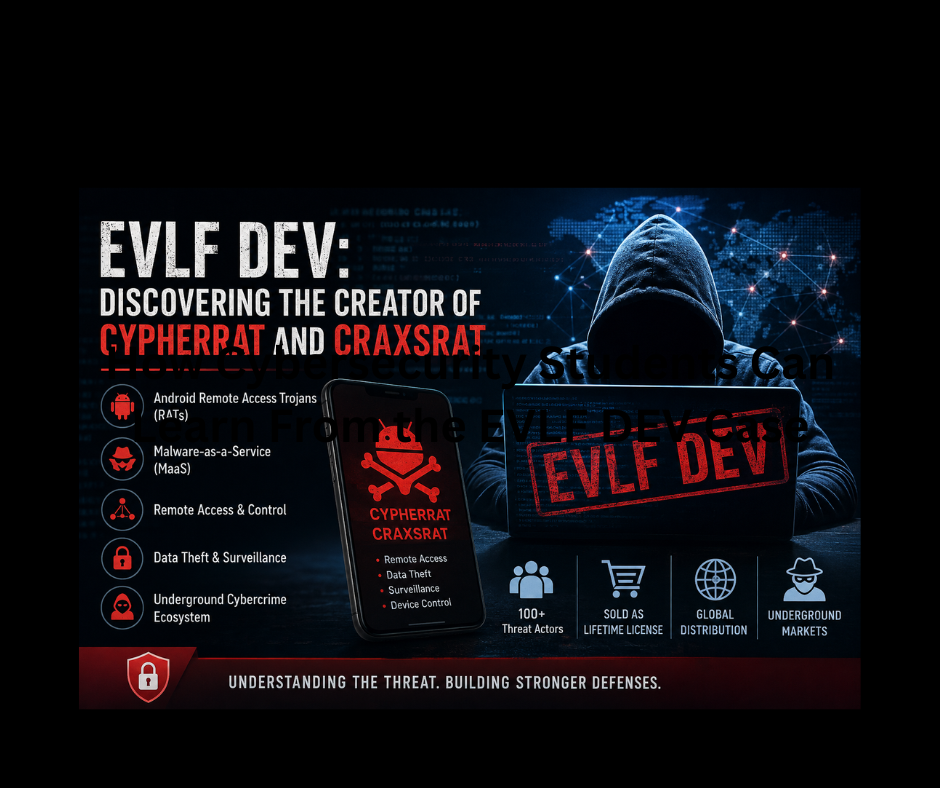
EVLF DEV became known in cybersecurity research as the developer and Malware-as-a-Service (MaaS) operator associated with CypherRAT and CraxsRAT, two Android-focused Remote Access Trojans (RATs). The case attracted significant attention because these malware families demonstrated how sophisticated Android surveillance and remote-control capabilities can be packaged and sold to other cybercriminals.
Cybersecurity researchers reported that CraxsRAT had been sold to more than 100 threat actors through lifetime licenses, highlighting a growing problem in modern cybercrime: attackers do not always need to develop malware themselves. Instead, they can purchase ready-made malicious tools through the underground economy.
This article explains who EVLF DEV is, what CypherRAT and CraxsRAT are, how Android RAT malware works at a high level, why Malware-as-a-Service is dangerous, and what organizations and users can do to improve mobile cybersecurity.
Who Is EVLF DEV?
EVLF DEV is the online identity associated with the developer behind CypherRAT and CraxsRAT. According to research published by CYFIRMA, the operator had been involved in developing and selling Android Remote Access Trojan malware through a Malware-as-a-Service business model.
CYFIRMA reported that the malware had attracted more than 100 distinct threat actors through lifetime licenses. Researchers also linked the operation to the sale of CraxsRAT through an online store.
The significance of EVLF DEV is not simply the identity of one malware developer. The larger cybersecurity lesson is how commercialized cybercrime lowers the technical barrier for attackers.
Instead of spending months developing a remote access trojan, an attacker can potentially acquire an existing tool, customize it, and use it against targets.
Why the EVLF DEV Case Matters
The case demonstrates several important cybersecurity trends:
- Growth of Malware-as-a-Service
- Commercialization of cybercrime
- Increasing threats against Android devices
- Remote access trojans becoming easier to obtain
- Use of malware builders and customizable payloads
- Credential theft and surveillance risks
- Increasing importance of mobile application security
- Need for stronger cybersecurity awareness
SecurityWeek also reported on CYFIRMA's research, noting the connection between EVLF DEV and the development and sale of CypherRAT and CraxsRAT.
What Are CypherRAT and CraxsRAT?
CypherRAT and CraxsRAT are Android Remote Access Trojans designed to provide attackers with remote capabilities over compromised devices.
A Remote Access Trojan, commonly called a RAT, is a type of malware that attempts to give an unauthorized person control or access to a victim's device.
Depending on the malware and permissions obtained, an Android RAT may attempt to:
- Collect sensitive information
- Monitor device activity
- Access files
- Capture information from the device
- Track location
- Interact with device sensors
- Communicate with attacker-controlled infrastructure
- Steal credentials or other valuable information
CYFIRMA's investigation described capabilities associated with the malware including remote actions and access to functions such as the camera, microphone, and location.
The exact capabilities of a particular sample can vary. Security researchers therefore analyze individual malware samples rather than assuming every version behaves identically.
How Does an Android RAT Threat Work?
At a high level, an Android RAT attack generally follows a sequence similar to this:
1. Initial Delivery
The attacker first needs to convince a victim to install or interact with a malicious application.
Common social engineering techniques can include:
- Fake applications
- Malicious links
- Phishing messages
- Fake updates
- Impersonation
- Untrusted APK downloads
- Social media messages
2. Installation and Permissions
Once installed, malicious applications may attempt to obtain permissions that provide access to sensitive device functionality.
This is why Android permission management is an important part of mobile security.
3. Remote Communication
A RAT may communicate with attacker-controlled infrastructure, commonly referred to as command-and-control or C2 infrastructure.
This communication can allow the attacker to send instructions to the compromised device.
4. Data Collection
Depending on its design and permissions, malware may attempt to collect sensitive information from the device.
5. Remote Control or Follow-Up Activity
The attacker may then attempt additional actions based on the capabilities of the malware and the access available on the compromised device.
This makes RAT detection and mobile threat monitoring important components of a modern cybersecurity strategy.
Why CraxsRAT Became a Major Cybersecurity Concern
CraxsRAT received attention because it was not simply an isolated malware sample. It was associated with a MaaS ecosystem, where malware could be offered to other cybercriminals.
This changes the threat model considerably.
A traditional malware developer might create malware for personal use. A MaaS operator instead creates a product that other criminals can use.
That creates a multiplier effect.
Malware-as-a-Service Explained
Malware-as-a-Service is a cybercrime model in which malicious software or infrastructure is provided to other threat actors, often for payment.
The model can include:
- Malware builders
- Remote administration tools
- Phishing infrastructure
- Botnets
- Stolen credentials
- Command-and-control infrastructure
- Technical support
- Subscription or lifetime access
This resembles legitimate software-as-a-service from a business-model perspective, but the underlying activity is criminal.
The EVLF DEV case is therefore important because it illustrates how the cybercrime economy can industrialize malware distribution.
Android Malware and the Growing Mobile Security Risk
Mobile devices have become an important part of personal and business computing.
People use smartphones for:
- Banking
- Payments
- Authentication
- Business communication
- Cloud services
- Social media
- Corporate applications
- Personal photographs and documents
A compromised smartphone can therefore expose considerably more than just device data.
The 2026 Verizon Data Breach Investigations Report highlights the growing importance of mobile-centric social engineering. Verizon reports that click rates for mobile-centric vectors such as voice and text messaging were 40% higher than email in its phishing simulations.
This reinforces an important cybersecurity principle: mobile security is no longer optional.
Latest Cybersecurity Threat Insights
Modern cyber threats are increasingly interconnected. Android malware is one part of a larger cybersecurity landscape involving phishing, ransomware, software exploitation, credential attacks and AI-assisted cybercrime.
Cybersecurity MetricLatest Reported InsightBreaches beginning with software vulnerabilities31%Breaches involving ransomware48%Attack techniques enhanced by generative AI15%Higher click rates for mobile-centric vectors vs email40%Global average data breach costUS$4.44 millionIndia average data breach cost₹220 million
Sources: Verizon 2026 Data Breach Investigations Report; IBM Cost of a Data Breach Report 2025.
The figures show why organizations need to think beyond traditional desktop security. Mobile devices, applications, identities, APIs and cloud infrastructure all form part of the modern attack surface.
How to Protect Against Android RAT Malware
There is no single security control that can eliminate every malware threat. A layered cybersecurity approach is more effective.
For Individual Android Users
Follow these basic mobile security practices:
- Install applications from trusted sources.
- Avoid unknown APK files and suspicious download links.
- Review application permissions carefully.
- Keep Android and applications updated.
- Use reputable mobile security solutions.
- Enable multi-factor authentication where available.
- Never provide sensitive information to suspicious applications.
- Be cautious with unexpected SMS, WhatsApp and social media links.
- Remove applications you no longer need.
- Monitor unusual battery, network or device behavior.
For Organizations
Businesses should take a broader approach to mobile threat protection.
Important controls include:
- Mobile Device Management (MDM)
- Endpoint Detection and Response (EDR)
- Mobile Application Security Testing
- Vulnerability Assessment and Penetration Testing
- Security awareness training
- Identity and Access Management
- Multi-factor authentication
- Network monitoring
- Incident response procedures
- Threat intelligence
- Secure application development
Mobile Application Security and Penetration Testing
The EVLF DEV case also demonstrates why mobile application security testing matters.
Modern applications often process authentication credentials, personal information, payment details, API keys and business data.
OWASP's 2024 Mobile Top 10 identifies risks including improper credential usage, insecure authentication, insecure communication, inadequate privacy controls, security misconfiguration, insecure data storage and insufficient cryptography.
Mobile penetration testing helps security teams identify weaknesses before attackers can exploit them.
A professional mobile application security assessment can examine:
- Android applications
- iOS applications
- APIs
- Authentication mechanisms
- Authorization controls
- Local data storage
- Network communication
- Application configuration
- Sensitive information exposure
- Backend services
For organizations seeking professional mobile security testing, MrWebSecure Mobile Application Penetration Testing provides mobile application security assessment and penetration testing services.
How Cybersecurity Professionals Analyze Android Malware
Malware analysis is an important cybersecurity skill for security analysts, threat researchers and penetration testers.
A controlled malware analysis environment may involve:
Static Analysis
Researchers examine a sample without executing it to understand:
- Application structure
- Permissions
- Strings
- Embedded resources
- Code
- Configuration
- Suspicious components
Dynamic Analysis
The sample is executed in an isolated environment so analysts can observe its behavior.
They may investigate:
- Network connections
- File activity
- Process behavior
- System interactions
- Runtime behavior
- Communication patterns
Network and Threat Intelligence Analysis
Analysts can also investigate indicators associated with malware campaigns, including domains, IP addresses, hashes and other infrastructure indicators.
The objective is not to deploy malware but to understand its behavior and improve detection and defense.
What Does the EVLF DEV Case Teach Cybersecurity Students?
The EVLF DEV and CraxsRAT story provides a practical example of several cybersecurity concepts.
Students learning ethical hacking and cybersecurity can use cases like this to understand:
- Malware analysis
- Android security
- Remote Access Trojans
- Command-and-control infrastructure
- Threat intelligence
- Social engineering
- Mobile penetration testing
- Incident response
- Digital forensics
- Cyber threat hunting
- Malware-as-a-Service
For students looking for practical cybersecurity education, MrWebSecure's Cyber Security & Ethical Hacking Training covers cybersecurity and ethical hacking concepts with practical learning.
Students interested specifically in mobile security can also explore the Certified Mobile Penetration Tester program, which covers Android and iOS mobile application penetration testing.
Key Takeaways
- EVLF DEV was identified by CYFIRMA as the developer and MaaS operator associated with CypherRAT and CraxsRAT.
- CraxsRAT was reportedly sold to more than 100 threat actors through lifetime licenses.
- CypherRAT and CraxsRAT demonstrate the risks associated with Android Remote Access Trojans.
- Malware-as-a-Service makes sophisticated malicious capabilities more accessible to cybercriminals.
- Mobile devices are increasingly attractive targets for cyber attacks.
- Phishing, malicious applications and social engineering remain important infection routes.
- Mobile application security testing can help identify weaknesses before attackers exploit them.
- Cybersecurity professionals need skills in malware analysis, threat intelligence, mobile security and penetration testing.
Conclusion
The story of EVLF DEV and the development of CypherRAT and CraxsRAT illustrates how rapidly the cybercrime ecosystem has evolved. Malware is no longer always developed by individual attackers for a single campaign. Through Malware-as-a-Service, malicious capabilities can be packaged, commercialized and distributed to multiple threat actors.
For businesses, the lesson is straightforward: protecting laptops and servers alone is not enough. Smartphones, mobile applications, APIs, identities and cloud environments must also be included in a modern cybersecurity strategy.
For cybersecurity students and professionals, cases involving Android RAT malware provide valuable real-world context for learning malware analysis, mobile application security, ethical hacking, penetration testing and cyber threat intelligence.
As cyber threats continue to evolve, practical cybersecurity knowledge becomes increasingly important. Building strong defensive skills through structured cybersecurity and ethical hacking training can help professionals understand how attacks work and, more importantly, how to prevent them.
Frequently Asked Questions
1. Who is EVLF DEV?
EVLF DEV is the online identity associated with the developer and Malware-as-a-Service operator behind CypherRAT and CraxsRAT, according to research published by CYFIRMA.
2. What is CraxsRAT?
CraxsRAT is an Android Remote Access Trojan associated with the EVLF DEV MaaS operation. It was designed to provide attackers with remote capabilities over compromised Android devices.
3. What is CypherRAT?
CypherRAT is an Android RAT associated with the same developer identified as EVLF DEV. It is part of the broader Malware-as-a-Service ecosystem investigated by cybersecurity researchers.
4. What is an Android RAT?
An Android RAT, or Remote Access Trojan, is malware designed to provide unauthorized remote access or control over an Android device.
5. How does Android RAT malware spread?
Android RATs can be distributed through phishing links, malicious APK files, fake applications, social engineering, impersonation and other deceptive delivery methods.
6. Is CraxsRAT a legitimate Android application?
No. CraxsRAT is associated with malicious activity and should not be confused with legitimate remote-support applications.
7. How can I protect my phone from Android malware?
Keep your operating system updated, install applications from trusted sources, review permissions, avoid suspicious APK files and links, use multi-factor authentication and maintain strong mobile security practices.
8. What is Malware-as-a-Service?
Malware-as-a-Service is a cybercrime model in which malicious software, infrastructure or related capabilities are offered to other criminals, often through paid access.
9. Why is mobile application security important?
Mobile applications can process passwords, financial information, personal data and business information. Security testing helps identify weaknesses that attackers could potentially exploit.
10. Can cybersecurity students learn malware analysis?
Yes. Malware analysis is an important cybersecurity discipline. Students can learn concepts such as static analysis, dynamic analysis, threat intelligence, digital forensics and incident response in controlled and legal environments.